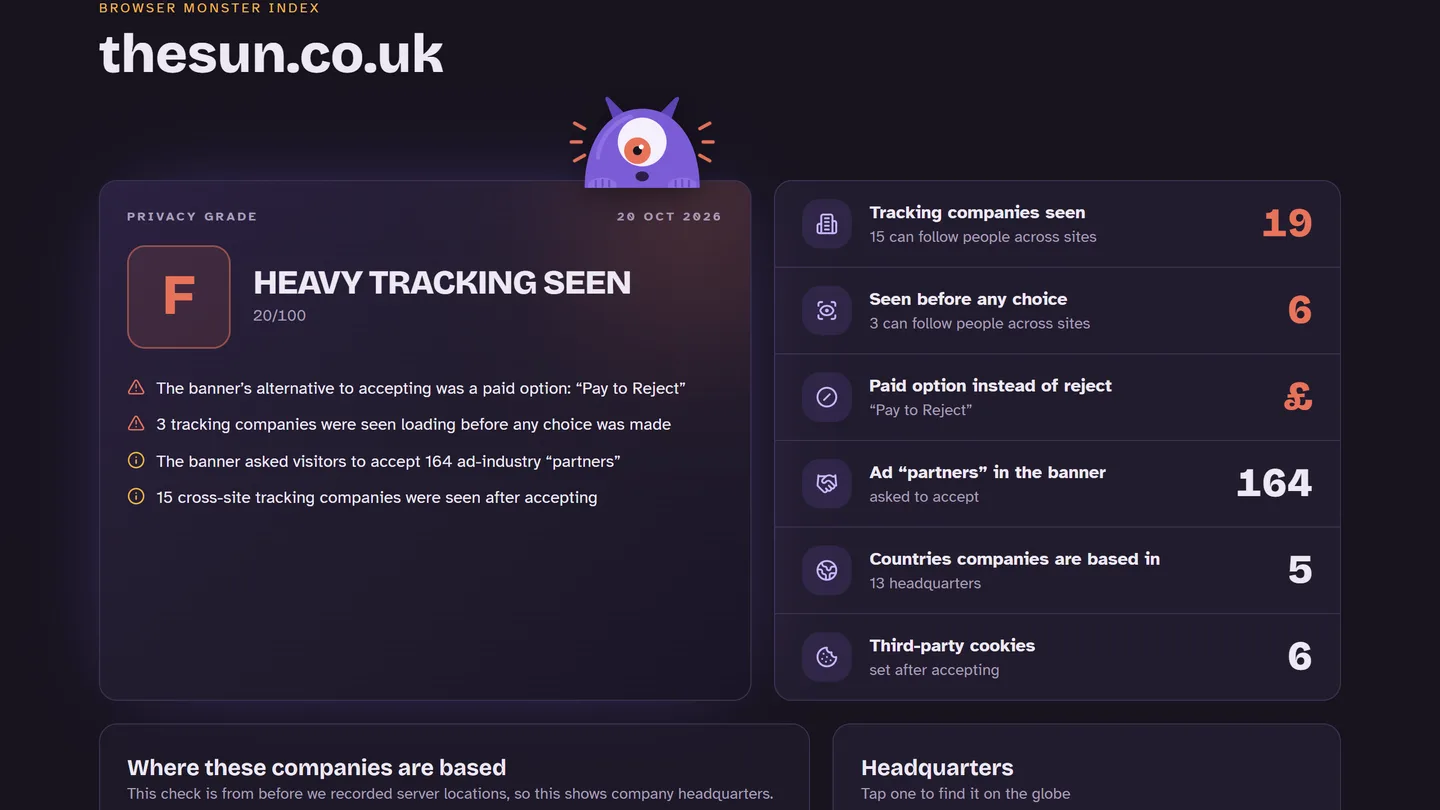
You open a news story and the cookie banner gives you two buttons: “Accept” or “Reject and pay”. There is no free way to say no. This is called consent or pay (or “pay or OK”), and it’s spreading across UK publishing. Here’s what it is, how common it is, what the regulators say and what you can do.
What “consent or pay” means
Most cookie banners let you refuse tracking for free. A consent-or-pay banner doesn’t. Your choices are to let the site and its advertising partners use cookies and similar technology to profile you, or to pay for a version that doesn’t. The paid version is often a subscription with fewer or no personalised ads, sometimes with other perks.
Publishers say it’s a fair trade: journalism costs money, and personalised ads pay more than ordinary ones. Critics say a choice between handing over your data and paying isn’t a free choice, especially when the “accept” button covers hundreds of companies.
How common is it?
17
of 138 checked UK sites offered a paid option instead of a free reject
14
of those 17 were news sites
983
ad partners: the most any of them asked visitors to accept
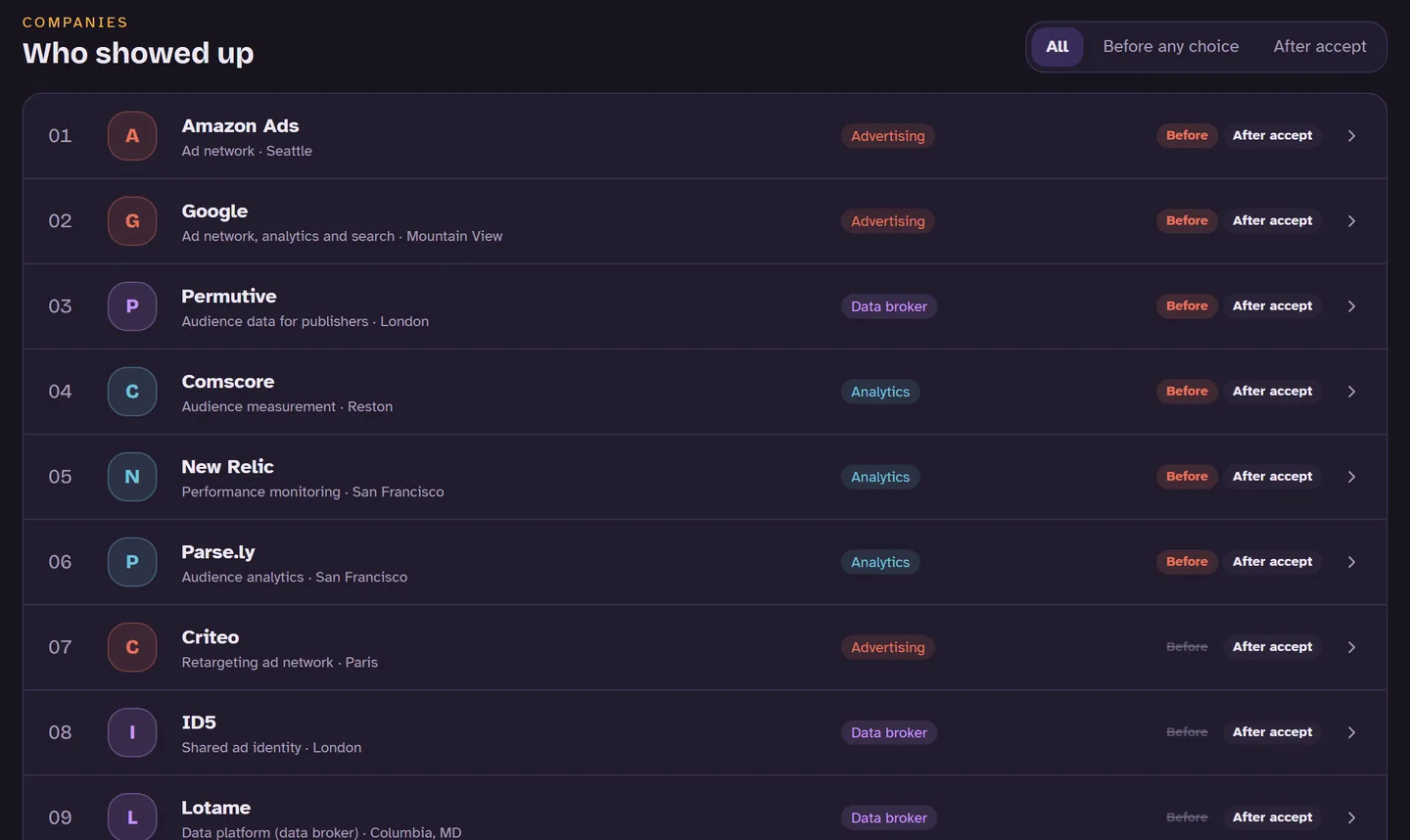
These are the 17 sites. The ad-partner figure is how many advertising companies the banner asked you to accept; the last column is how many tracking companies we actually saw on the page after we accepted.
| Site | Button wording | Ad partners to accept | Tracking companies seen |
|---|---|---|---|
| express.co.uk | “Reject and Pay” | 983 | 41 |
| mirror.co.uk | “Reject and Pay” | 979 | 41 |
| cityam.com | “Reject & Pay £4” | 952 | 37 |
| birminghammail.co.uk | “Reject and Pay” | 942 | 44 |
| dailyrecord.co.uk | “Reject and Pay” | 942 | 44 |
| liverpoolecho.co.uk | “Reject and Pay” | 942 | 43 |
| manchestereveningnews.co.uk | “Reject and Pay” | 942 | 42 |
| chroniclelive.co.uk | “Reject and Pay” | 942 | 42 |
| walesonline.co.uk | “Reject and Pay” | 942 | 41 |
| gbnews.com | “Pay to Reject” | 529 | 36 |
| goal.com | “Reject & Pay” | 181 | 38 |
| scotsman.com | “Reject & subscribe” | 180 | 35 |
| parkers.co.uk | “Pay To Reject” | 167 | 34 |
| thesun.co.uk | “Pay to Reject” | 164 | 19 |
| standard.co.uk | “Reject & Pay” | 99 | 35 |
| bbcgoodfood.com | “Reject & Pay” | 92 | 30 |
| independent.co.uk | “Pay to remove ads” | Not shown | 8 |
Outside the Index, we saw the same model on The Guardian, whose banner on 24 October 2026 offered “Accept all” or “Reject all and subscribe to Guardian Ad-Lite for £5 per month”, and on Germany’s Der Spiegel, which offered “Consent and continue” or “Subscribe now”.
Is it allowed?
In the UK, consent or pay isn’t banned. In January 2025 the Information Commissioner’s Office published guidance for organisations using it. Consent still has to be freely given and informed, and the ICO said it would look at four things:
- Power balance: whether people have a realistic choice, or depend on the service so much that they can’t really refuse.
- The fee: a price that’s inappropriately high isn’t a real alternative.
- Equivalence: the paid and the “accept” versions should offer an equivalent core service.
- Presentation: both options should be shown clearly and equally, with no pressure or misleading design.
In the EU, the European Data Protection Board said in April 2024 (Opinion 08/2024) that a simple “consent or pay” choice will, in most cases, not give valid consent when it’s used by large online platforms. It said those platforms should also offer a free alternative without behavioural advertising. That opinion is about the biggest platforms; for ordinary publishers, national regulators decide case by case.
Our grade doesn’t decide the law
What you can do
- Pay, if you value the site. Check what the subscription actually removes: some remove personalised ads, some remove all ads.
- Accept, then clean up. Your data is shared while you browse, but you can delete that site’s cookies afterwards. Browser Monster can clear cookies by site or by company in one click.
- Read the same story elsewhere. Many news stories are covered by sites that let you refuse for free. Check a site’s grade first on Check a site.
- Complain if the deal looks unfair. If a fee seems disproportionate or the options are presented unfairly, you can raise it with the ICO at ico.org.uk.
If you use Browser Monster’s auto-reject, it deliberately leaves these banners alone: it will never press a paid option for you, and it tells you the site wants payment to refuse.
Know what you’re agreeing to
Browser Monster shows how many companies a banner asked you to accept, which ones loaded, and lets you clear them afterwards. Everything stays on your device.
Sources
- Browser Monster Index: live data and dashboard · Browser Monster, October 2026
- Consent or pay: ICO guidance and cookie compliance plans · Press Gazette, 23 January 2025
- ICO takes action to tackle cookie compliance across the UK’s top 1,000 websites · Information Commissioner’s Office, 23 January 2025
- Opinion 08/2024 on valid consent in the context of consent or pay models implemented by large online platforms · European Data Protection Board, 17 April 2024
- Key points from EDPB Opinion 08/2024 on “consent or pay” models · Simmons & Simmons